Beyond the Pipeline: The Three Stages of AI System Awareness
Self-knowledge. Institutional knowledge. Environmental awareness. What comes after pipeline maturity.
Part 2 of the 9 Stages framework
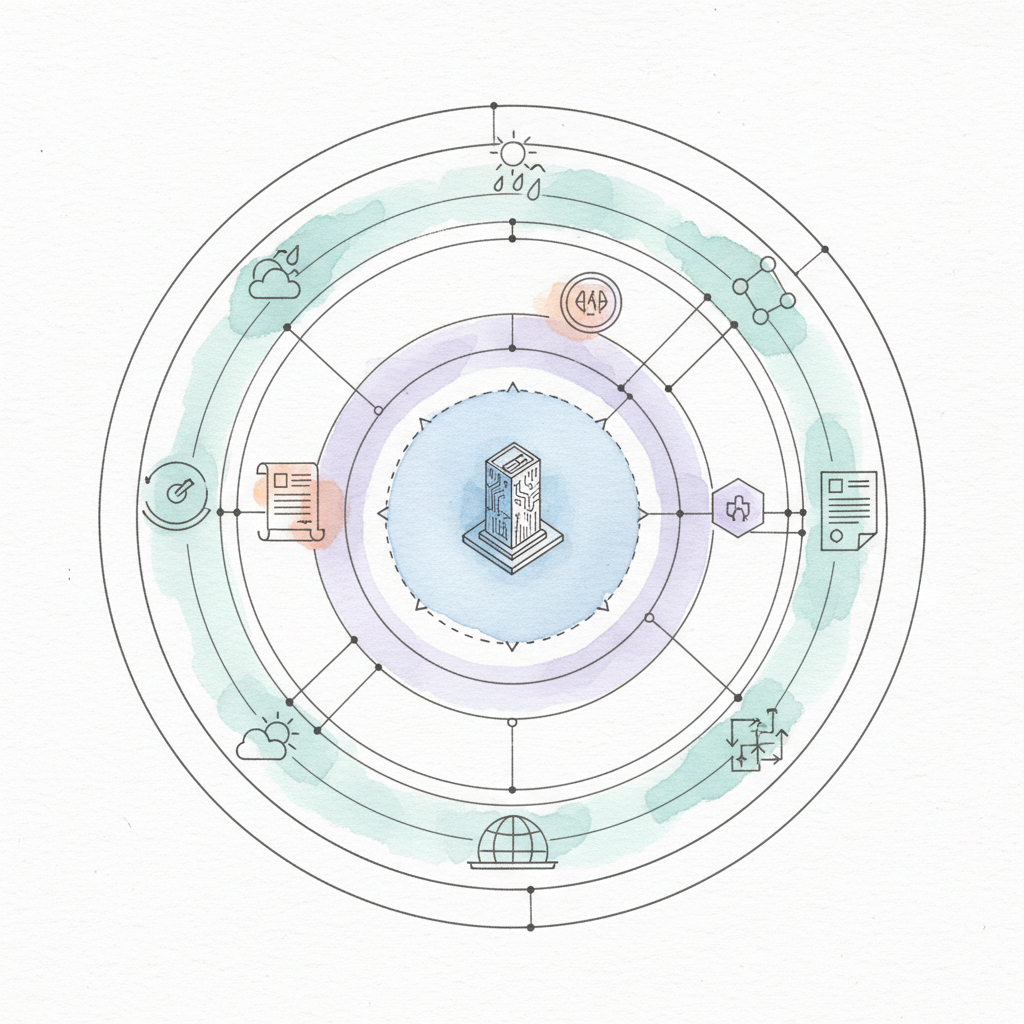
Stages 7–9: an expanding sphere of awareness — self, organisation, environment
The System Knows Itself
Knowledge accumulation · Current-state descriptor · Steward agents
Stage 7 is where the pipeline stops treating each production run as isolated. It develops inner awareness: it knows what it built, what happened during production, what failed, what was remediated, and what the current state of the system is.
Every pipeline run writes structured data to a persistent store: specs, deficiency records, severity classifications, resolution paths, stall events, model performance metrics, scores per phase, tickets, review artefacts, test outcomes, and remediation history.
“Every pipeline run adds to what the system knows. Nothing is forgotten.”
Without governed knowledge, all of this is scattered across JSON state files, review artefacts in directories, and git trailers on commits. Stage 7 is where that changes. The knowledge is classified, maintained, versioned, and made available to agents and pipeline phases that need it.
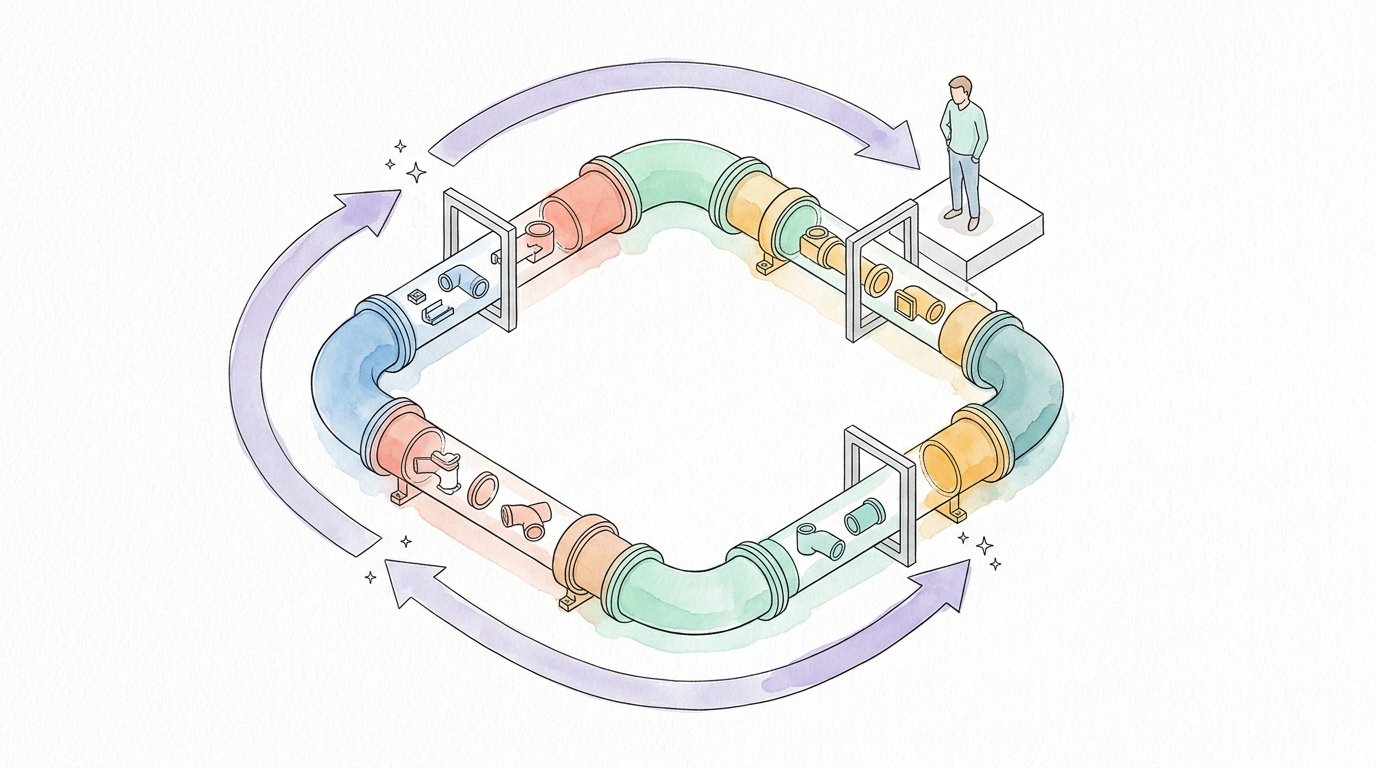
The pipeline accumulates governed knowledge across every production run
Nine required knowledge classes
All stored knowledge must be explicitly categorised. Without classification, retrieval quality collapses and the knowledge base becomes a dump rather than a resource.
Business goals, product purpose, domain requirements. Why this system exists.
Regulatory rules, security policies, organisational policies. What rules govern it.
Architecture, invariants, interfaces, ADRs with rationale and expiration conditions.
The current-state system descriptor. What it actually is right now — not what was planned.
Test results, incidents, deficiency records, failure patterns, remediation history.
Pipeline profiles, production rules, workflow definitions. How it is built and operated.
Concurrency behaviour, failure modes, transaction boundaries, cache semantics.
Schemas, migrations, lifecycle constraints, storage ownership. How data evolves.
Trust boundaries, threat models, authentication semantics, dependency risk.
Three document layers coexist from Stage 7 onward
Implementation always discovers things original documents did not know. The Reality layer captures what was actually built, not what was planned.
PRD
Why the system exists. Business goals, product purpose, domain requirements.
Spec
How the system was planned. Architecture, interfaces, invariants, acceptance criteria.
Current-State Descriptor
What the system actually is right now. Components, runtime behaviour, deployment topology, invariants.
The current-state system descriptor
The system must maintain a continuously updated, as-built description of what the system actually is right now. Separate from PRDs (intent) and specs (planned design) — the descriptor describes reality.
The descriptor requires its own lifecycle: evidence gathering, synthesis, validation, versioning. If maintained too manually, it goes stale. If too automatically generated, it becomes polished fiction. The hard problem is not generating a description — it is keeping it truthful.
Every statement must carry an explicit epistemic status: intended, implemented, observed, inferred, validated, disputed, deprecated, or provisional. Many facts are only true in specific contexts — behind a feature flag, after a migration, in one tenant but not another.
The Clean Rebuild
A system with mature Stage 7 capabilities can take everything learned from a messy development history — every deficiency, edge case, security finding, performance issue, behavioural contract, architectural lesson — synthesise it into a new specification set, and produce a clean codebase built to target quality with all hard-won knowledge baked in from day one.
The specs are not re-derived from scratch. They inherit the full accumulated context: anti-requirements from every failed edge case, invariants from every incident, security constraints from every finding.
The organisation’s investment is not in the code. It is in the spec history, the deficiency history, the organisational context, and the behavioural contracts. The code is regenerated. Nothing learned is lost.
Stewardship at Stage 7
- Detect degradation, correlate with past incidents
- Propose maintenance informed by production history
- Manage deployment health and rollback decisions
- Initiate clean rebuilds when accumulated debt warrants
- Budget constraints — limit compute and resource expenditure
- Risk thresholds — cap the maximum blast radius for autonomous changes
- Scope boundaries — maximum size of change without human review
These are not restrictions to be relaxed. They are a constitutive feature of governed autonomy.
The System Knows Who It Serves
Organisational knowledge · Regulatory reasoning · Institutional correctness
Self-knowledge from Stage 7 is now mature. Stage 8 adds a new knowledge domain: understanding the institution the system serves and the regulatory landscape around it.
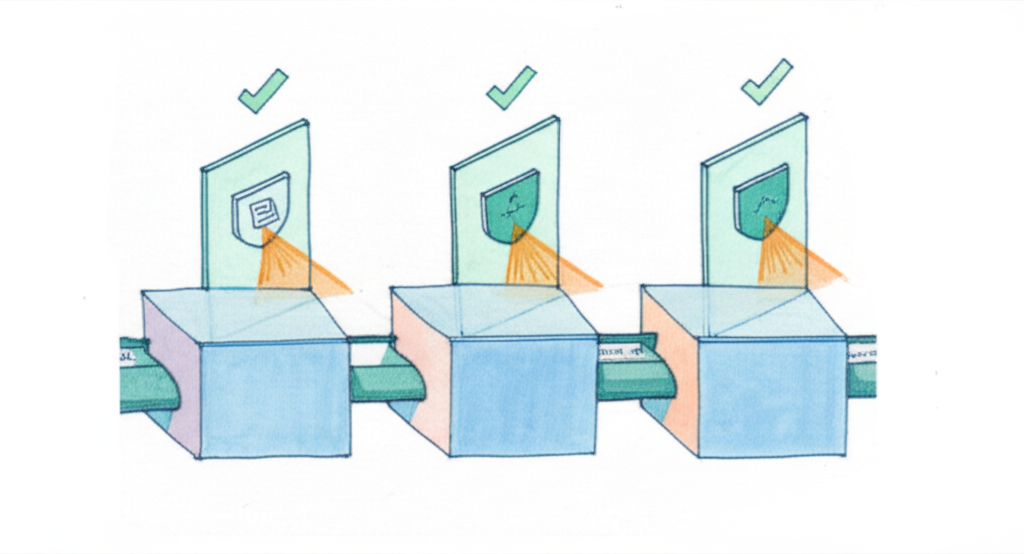
When generating a new artefact, the pipeline applies the organisation’s coding conventions automatically, applies security rules without being told, uses approved infrastructure patterns without the spec needing to enumerate them. Institutional correctness becomes a property of output, not a checklist to verify after the fact.
“A hospital in Toronto implies PHIPA. The system knows that without being told.”
Specifications become shorter and more focused because all boilerplate institutional requirements are inferred rather than stated. Specifiers describe intent and behaviour — the pipeline applies institutional and regulatory constraints as a function of knowing who it is working for.
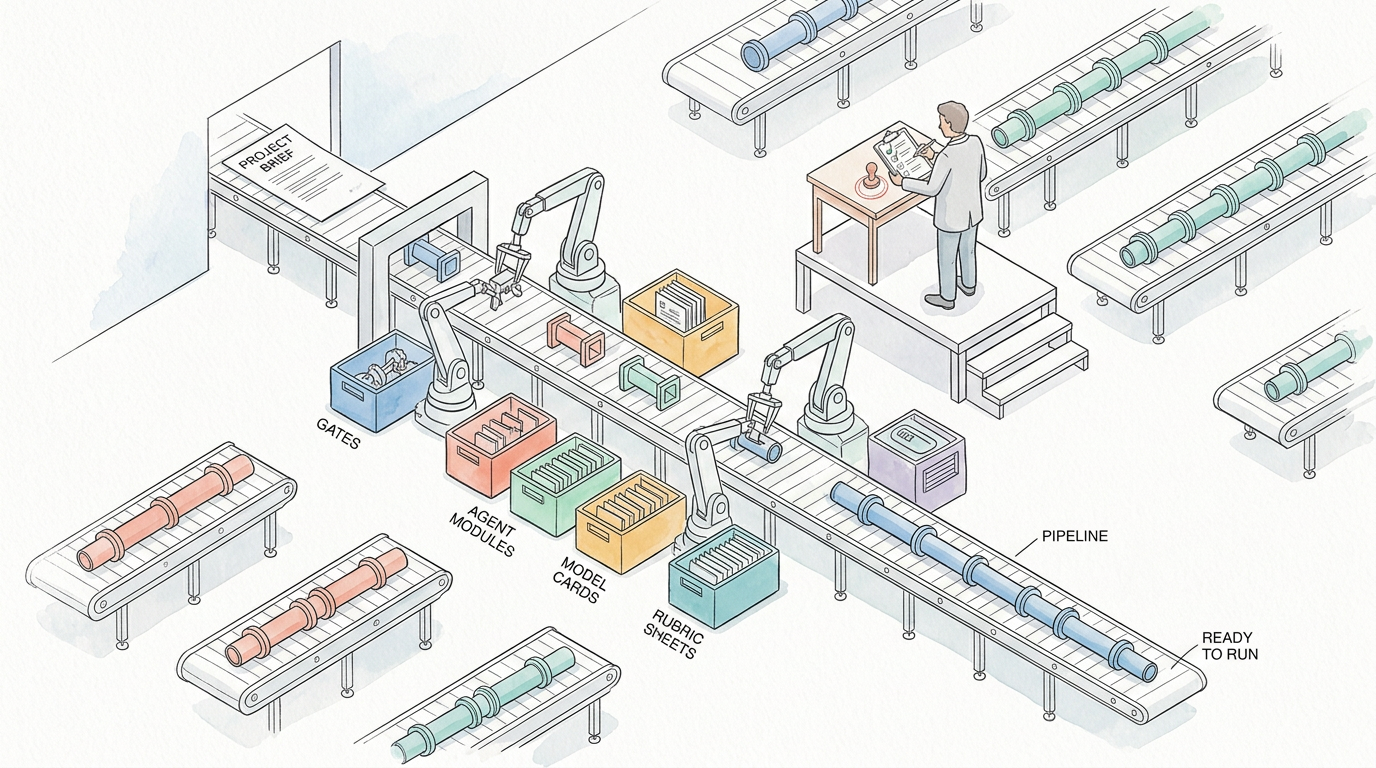
Artefacts are no longer generic — they are institutionally correct
A worked example of Stage 8 inference
A hospital in Toronto implies PHIPA privacy obligations, Ontario healthcare regulations, provincial reporting requirements, healthcare audit logging, healthcare data standards, and hospital-specific operational policies. A specification for a patient intake workflow does not need to enumerate the privacy requirements — those are part of what it means to build that kind of system for that kind of organisation.
What Stage 8 is actually about
Stage 8 is not about having access to more documents. Most organisations have captured far more institutional knowledge than they realise. The problem is three things.
Discovery
The organisation does not know what it knows. The information is captured but scattered across dozens of systems and formats. A security policy exists somewhere. An infrastructure standard exists somewhere else. The knowledge is there but effectively invisible at the moment it’s needed.
Synthesis
Even when information is found, it must be combined, reconciled, and interpreted. A security policy says one thing. An infrastructure standard says something different. A regulatory requirement adds a third constraint. A human expert synthesises these — but that synthesis happens in the expert’s head, is not recorded, and must be repeated every time.
Application
Even when knowledge is discovered and synthesised, applying it consistently across all artefact production is a process problem. A developer building a new service may or may not check the security policy wiki. Stage 8 builds the machinery to find knowledge, combine it coherently, and apply it reliably without human intervention at each step.

Every gate applies organisational and regulatory constraints automatically
Core capabilities at Stage 8
- Automatic policy inference — which organisational and regulatory policies apply to a given artefact, without spelling them out in every spec
- Domain modelling — entities, invariants, ownership rules, lifecycle events, bounded contexts at the institutional level
- Impact analysis with institutional context — regulatory consequences, policy compliance, cross-system effects on the broader ecosystem
- Versioning and compatibility reasoning — API versioning, schema evolution, data migration safety within the organisation’s ecosystem
- Security as a reasoning domain — trust boundaries, authentication semantics, secrets management, threat models, all evaluated within the organisation’s security posture
- Escalation and refusal — the ability to refuse is as important as the ability to produce
The System Knows the World Around It
Environmental monitoring · Goal-driven origination · Steward coordination
Stage 9 adds forward-looking, outward-facing awareness. The system monitors technology evolution, ecosystem shifts, user behaviour, dependency health, and external change.
Most significantly: the system proactively proposes work rather than waiting for specifications to be submitted. Steward agents reach full maturity, operating with comprehensive autonomy within governance constraints.
“The system doesn’t wait to be asked. It monitors, anticipates, proposes.”

Steward agents monitor continuously across four signal domains
Four signal domains
Steward agents at Stage 9 continuously monitor four signal domains, each with distinct character and distinct implications for what work should be proposed.
Performance degradation, crashes, runtime exceptions, error logs, failing validators, infrastructure warnings, resource usage spikes, latency increases, service outages. At Stage 9 these are evaluated with full institutional and environmental context — a latency increase may have regulatory implications.
Outdated documentation, diagrams inconsistent with code, tutorials no longer working, dataset drift, cross-artefact inconsistencies, stale descriptor sections. Frequently missed in systems without dedicated stewardship — the system keeps running while documentation slowly diverges from reality.
Regulatory updates, dependency upgrades and security advisories, API changes from external systems, infrastructure changes, new technologies, industry standard updates, organisational policy changes, branding updates. Stage 9 stewards propose artefact updates before the environment forces them.
Bug reports, feature requests, user suggestions, support tickets, survey responses, internal feedback, forum discussions, and conversational AI interactions. Unlike the other three domains, human signals are unstructured, sometimes contradictory, and require aggregation and pattern detection before they can drive meaningful work.
Goal-driven origination — the qualitative shift
The most significant capability introduced at Stage 9 is not signal monitoring. Stage 9 introduces a qualitative shift in how work is originated.
Every proposed piece of work passes through the governance layer — impact evaluation, budget assessment, approval thresholds, institutional compliance checks — before entering production. The system does not execute on goals unilaterally. It generates the map of what execution would require and submits that map for human review.